MechanOdd
69 MB
MechanOdd is a polyphonic physical-modelling synthesizer plugin (VST3/AU) built with JUCE. It synthesizes sound by exciting simulated mechanical resonators (strings, plates, membranes, and beams) and routing the results through a feedback matrix, effects chains, and a modulation engine.
CONCEPT
MechanOdd is built around the idea that interesting timbres arise from the interaction between excitation signals and resonant structures, rather than from either alone.
A typical path through the synth:
Sources generate raw signals (noise bursts, wavetable oscillators, crackling textures).
Resonators shape those signals using models of physical objects: a vibrating string, a struck plate, a drum membrane, a stiff beam.
A feedback matrix lets resonators feed back into each other and into the sources, creating coupled systems with complex emergent behaviour.
Effects polish the result (reverb, delay, EQ, saturation, cabinet simulation).
A modulation engine (LFOs + per-voice ADSRs) animates any parameter over time.
The synth is fully polyphonic (up to 8 voices). Each voice runs its own set of sources, per-voice resonators, and a modulation engine. A second tier of global resonators receives the summed output of all voices and processes it once per audio block, suitable for room-scale resonances shared across notes.
User Interface
Sources
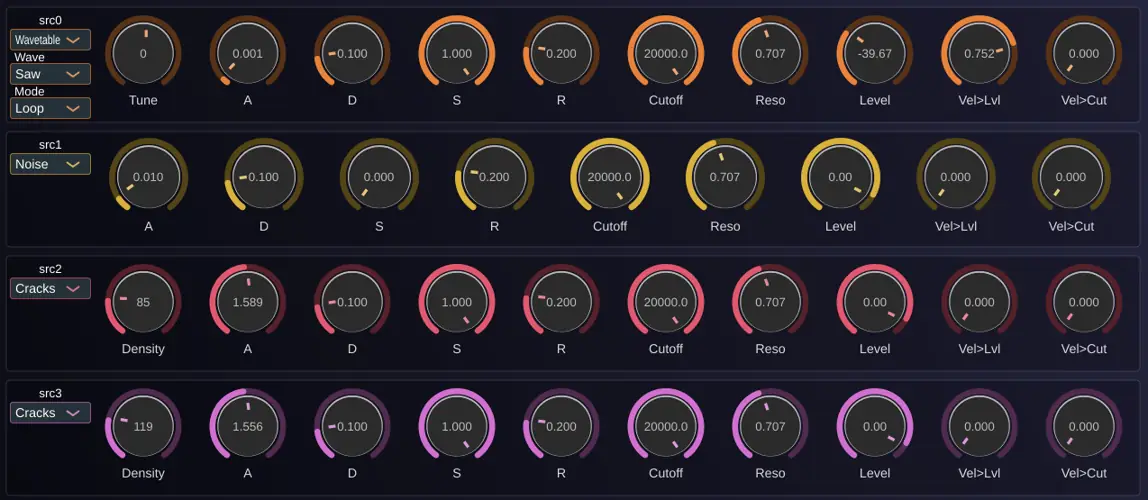
Four source slots (coloured orange, gold, rose, magenta) generate the excitation signals. Each slot can be independently tuned and shaped. Typical source types:
Wavetable: band-limited oscillator reading a stored waveform cycle.
Noise: spectrally shaped random signal, useful as a bow or breath approximation.
Cracks: sparse impulse train imitating plectrum picks or percussion strikes.
Sources feed into the columns of the feedback matrix.
Resonators
Four resonator slots (coloured teal, azure, lime, violet) model the physical structure being “played.” Each slot independently selects a resonator type and its associated parameters.
Resonators can run in two modes:
Per-voice: each polyphonic voice gets its own independent resonator instance, tuned to the note’s pitch.
Global: a single instance shared across all voices, processed once per audio block.
Feedback Matrix
A 4×9 routing grid. Each cell is a bipolar gain knob (centre = mute, edges = ±maximum gain):
Columns 1–4 carry the four source signals.
Columns 5–8 carry the four resonator outputs (fed back with a one-block delay).
Column 9 carries the processed send-bus output, fed back with a one-block delay (the re-entrant send chain).
Rows 1–4 feed the four resonators.
Each row also has a level, pan, and send control. The send bus routes signal into the Bus Effect Chain, whose output is both folded into the master mix and fed back into column 9 of the matrix.
Warning
Watch your output level when tweaking the matrix. Because multiple gain paths sum at the mix stage, the combined signal can peak well above 0 dBFS before it reaches the Master chain — even if individual cells appear modest. This is especially true when resonator-feedback columns (5–8) or the send-bus column (9) carry appreciable signal, as they form re-entrant loops that multiply on every block. Start with all cells near centre (muted) and raise gains gradually while watching the VU meter. Placing a Limiter as the last slot in the Master chain is strongly recommended as a safety ceiling whenever exploring high-gain or self-oscillating settings.
Effects
Two serial effect chains of four slots each:
Chain Purpose
Bus Applied to the send signal accumulated from all voices and resonators. Its output also re-enters the feedback matrix (column 9), forming a re-entrant effect loop
Master Applied to the final stereo mix, after the bus chain
Available effects per slot: Delay, Tube saturation, EQ, Octaver, Compressor, Limiter/maximizer, Transient shaper, Cabinet IR, Convolution Reverb.
Modulation
Twelve global modulators, each targeting any float parameter in the plugin. Two types:
LFO: continuously oscillating; selectable shape (Sine, Triangle, Square, Saw Up, Saw Down); rate in Hz or tempo-synced to host (1/1 down to 1/16T).
ADSR: triggered by MIDI note gates; global gate rises on the first note after silence, falls on the last note release.
Per-voice ADSRs mirror the global ADSR modulators but track individual note gates, so each voice can have independent envelope shapes even on the same target parameter.


MechanOdd.0.1.0 ( 70 MB )