Dynamics Plugins Bundle
42.5 MB
Analog gear, simulated from the circuit up. Most “analog modeled” plugins are a snapshot: measure the hardware, fit some curves, ship the curves. These solve the actual circuit while your audio runs through it. The tube bias shifts when you hit it hard. The transformer core saturates from flux, so it cares about frequency, not just level. The opto cell remembers what you played ten seconds ago. Nothing is drawn on; if a meter moves or a curve bends, something in the circuit did it.
And since the whole circuit is in there, you get the screwdriver too. Every module has a rear panel with the service trims the hardware kept locked inside: supply draw, bias, transformer headroom, tube swaps. Set them to factory and it behaves like a well-kept unit. Or don’t.
The lineup
WD Opto — optical tube compressor in the LA-2A bloodline. The photocell is the real thing: two time constants, program-dependent memory, that slow settling tail. Two voicings (tube WD-2A, solid-state WD-3A) plus drive and iron controls the original never gave you.
WD Mu — variable-mu compressor built around a simulated 6386 push-pull stage and the classic six-position time-constant bank. No threshold knob, because the circuit doesn’t have one; you drive it and it leans back. Bias knob on the front, mismatched tube pairs on the back.
WDTec — passive tube EQ, program and midrange sections in one wide module. The boost you can’t get wrong, with a twist: the filter inductors have live magnetic cores, and a Core knob sets how hard you push them.
WD Tape — a full tape machine. Record head, bias oscillator, reproduce head, all of it, aligned by the same procedure a tech would use on the hardware. Two stock formulations. Every unit number ships with its own transport quirks.
WD XQ — one parametric EQ, five circuits. Precision digital, two console flavors, a stepped American classic, and an inductor design from 1973. The knobs stay put while the circuit underneath changes what they’re allowed to do. Dynamic bands on all five.
WD FET — FET compressor with four circuit laws in one box: the 76 everyone reaches for, a crushed 760 sibling, a germanium path, and a clean precision law. The ratio network is solved from the 1176LN drawing, so all-buttons works because the circuit does it, not because we faked the curve. Attack is measured in microseconds.
WD VCA — stereo bus compressor built around one Blackmer-style gain cell. Two detector brains: Console Bus leans the whole mix back the way the famous desk compressor does, RMS Punch is for the drum bus. Auto release, over-easy knee, and the RMS detector’s attack table falls out of one capacitor, same as the hardware.
WD Duress — a curve-family compressor in the Distressor spirit. Every ratio position is its own engineered curve: 1:1 is warm-up distortion with no compression at all, 10:1 borrows an opto release with a twenty-second tail, and Nuke is a log-release brickwall. Three distortion modes, two stereo link laws taken from the block diagram, and a British Mode switch that overrides the envelope the way all-buttons abuse does.
WD Pre — five preamps behind one gain knob. Precision digital wire, a Class A British console with its iron, an American op-amp console, a German broadcast valve, and a cassette 4-track desk channel. Gain redistributes the circuit, so every detent is a slightly different amplifier; output is only a fader after the iron.
WD Echo — tape loop echo where the loop is real enough to have a splice. Motor-driven transport, three repro heads, spring tank. Repeat rate is a motor, not a delay dial: turn it and everything already on the loop bends with the transport. The time arrow reads the tape forward, palindrome, or straight-up backward.
WD AX — the exciter, built from the patents instead of around them. It adds a generated sideband rather than boosting EQ, so the fundamental never moves. The Big Bottom section lifts the decay of a note instead of its hit: sustain without the overload penalty.
WD Rack — the chassis. Put it on your master bus, give your modules the same frame number, and suddenly they’re screwed into the same box: shared power supply that sags when a neighbor works hard, adjacent-slot bleed, a slot map you can reorder. Crank the crosstalk and the rack becomes an effect of its own. Skip it entirely and every module runs clean standalone.
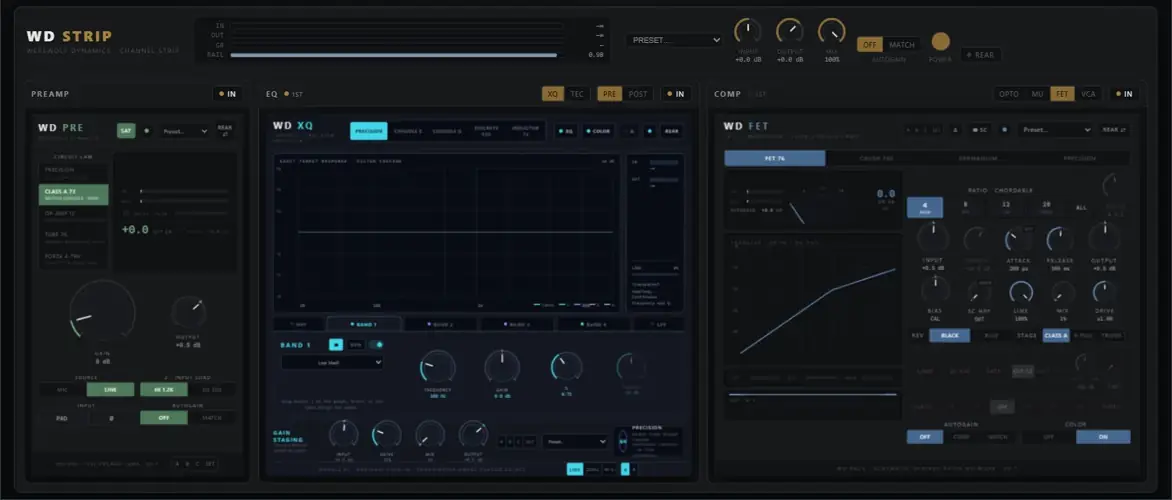
WD Strip — a console channel in one window: preamp into EQ into compressor, a model selector on each stage. Any of the five Pre laws, either EQ, any of the four compressors. All three stages hang off one power rail inside the same process, so the compressor’s knee moves when the preamp leans on the supply. No rack required.


Werewolf.Dynamics.0.6.0 ( 103 MB )