Retromulator
46.6 MB
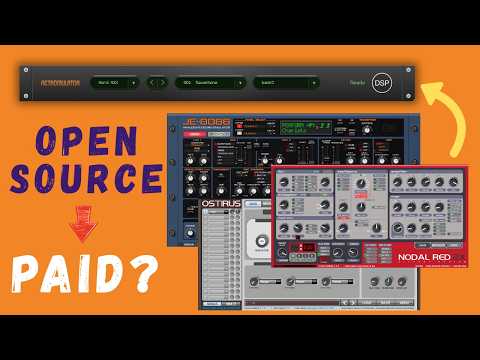
Multi-synth emulates retro synths via cycle-accurate hardware emulation. Retromulator brings legendary hardware cores back to life through authentic low-level emulation. The virtual analog synths are powered by a faithful recreation of the Motorola DSP 56300 processor, the Yamaha DX7 runs a full emulation of its original chip set, and the Akai S1000 sampler plays your SF2, SFZ, and Bliss sample banks with studio-quality interpolation. Each core runs its actual firmware or sample data — delivering the unmistakable character of hardware that defined electronic music from the early 80s through the 2000s.
Unlike traditional software emulations that recreate synthesizer behavior by approximation, Retromulator emulates the original integrated circuits at the hardware level. The virtual analog synths run on a cycle-accurate Motorola DSP 56300, the Yamaha DX7 runs a full emulation of its Hitachi HD6303R sub-CPU and Yamaha YM21280/YM21290 EGS/OPS chip set, and the Akai S1000 sampler runs on the SFZero v3.0.0 engine with 8-point sinc interpolation supporting SF2, SFZ, ZBP, and ZBB sample banks. Each core executes its authentic firmware or sample data exactly as intended.
Load the ROM firmware from your own hardware or sample banks from your library, place them in the designated folder, and Retromulator takes care of the rest. The result is not an approximation — it is the real hardware running inside your DAW.
Retromulator is built on Gearmulator, an open-source synthesizer emulation project by the dsp56300 team. We are grateful for their extraordinary work in bringing these classic instruments back to life.
The Akai S1000 defined the gold standard for studio sampling in the late 80s and early 90s, with its warm 16-bit converters and characteristic sound shaping the backbone of hip-hop, dance, and film score production. Retromulator’s S1000 core runs on the SFZero v3.0.0 MIT-licensed sample engine with 8-point sinc interpolation, extended SFZ/SF2 opcode support, and discoDSP Bliss sampler format (.zbp/.zbb). Full MIDI CC support includes mod wheel vibrato, volume, expression, pan, sustain pedal, and pitch bend.
The Access Virus series defined a generation of electronic music with its aggressive, characterful virtual analog sound engine. Released from 1997 onwards, the Virus A introduced a highly efficient DSP-based architecture capable of rich pads, cutting leads, and complex modulation — all at a time when CPU power was limited. The B and C revisions expanded polyphony, added new filter modes, and refined the overall sound.
The Virus TI (Total Integration) brought unprecedented polyphony, multi-timbrality, and DSP power when it launched in 2005. Its expanded synthesis capabilities, analog-modeled filters, and deep modulation matrix made it a go-to instrument for producers and live performers worldwide. The TI2 and Snow variants extended the platform further with additional DSP headroom and a compact form factor.
The Nord Lead 2X was Clavia’s definitive revision of the iconic Nord Lead 2, adding a dual-DSP56300 architecture for expanded polyphony and richer unison. Its analog-modeled oscillators, classic Nord filter character, and immediate hands-on playability made it one of the most sought-after performance synthesizers of its era.
The Roland JP-8000 is the synthesizer that brought the supersaw waveform to the world — a stacked, detuned oscillator algorithm that became the defining sound of late 90s trance and electronic dance music. Beyond the supersaw, the JP-8000 offered a full virtual analog architecture with powerful filters, a motion control ribbon, and an expressive modulation system.
Waldorf’s microQ distilled the architecture of the legendary Q synthesizer into a compact, affordable rackmount. Its wavetable oscillators, three filters per voice, and sophisticated modulation matrix earned it a devoted following among sound designers seeking the distinctive Waldorf digital-analog hybrid character — complex, evolving timbres that no purely analog instrument could produce.
The Waldorf Microwave XT combined PPG-style wavetable synthesis with modern analog filters to create one of the most distinctive synthesizers of the late 90s. Its evolving, complex timbres — sweeping through wavetables with lush resonant filters — became a hallmark of progressive electronic and cinematic music production.
The Yamaha DX7 is the best-selling synthesizer of all time and the instrument that brought FM synthesis to the mainstream. Released in 1983, its six-operator FM engine produced the iconic electric pianos, basses, bells, and pads that defined the sound of the 80s across pop, jazz, and film scores. Retromulator emulates the DX7 at the hardware level using VDX7 — reproducing the Hitachi HD6303R sub-CPU, Yamaha YM21280 EGS (Envelope Generator), and YM21290 OPS (Operator) chip set that made the original instrument possible.


Retromulator.1.1 ( 46 MB )